
This Month in Oxfordian History – October
Macbeth & Oxford’s Scots Connections
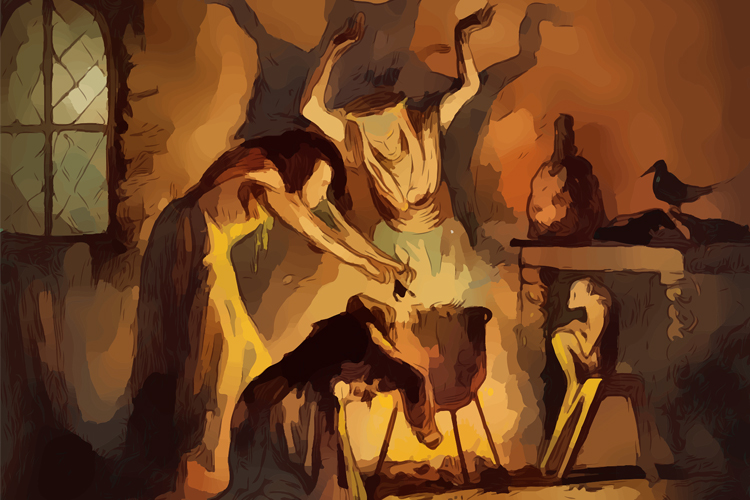
“Round about the cauldron go; / In the poison’d entrails throw.
— Macbeth: Act 4, Scene
By Sara Hill
In October of 1586 Mary, Queen of Scots, was found guilty of treason by a jury of English noblemen, including Edward de Vere, 17th Earl of Oxford. The executioner’s ax fell upon her in early 1587.
Just as in Macbeth the murdered Duncan’s “double trust” as kinsman, subject, and guest was violated, so too was the refuge and protection Mary originally sought from her cousin Elizabeth in 1568. Although carried out “under color of law,” it was nonetheless a regicide that echoed an earlier one in which Mary was involved, if only as victim.
That was the murder in 1567 of Mary’s husband, Charles Stuart, Lord Darnley, in a scheme that was perhaps designed to implicate Mary, not unlike Lady Macbeth, as accomplice. Researchers have cited Darnley’s murder (and other contemporary regicides) as impulse and partial model for Shakespeare’s Macbeth.
The Earl of Oxford’s Scottish connections are numerous, while documented connections to the Stratford man not only do not exist, but in some cases rule him out entirely. For instance, in 1568 a lost play, The Tragedie of the King of Scots, author unknown, was performed for Elizabeth in London. That this was a dramatization of Lord Darnley’s murder and a possible precursor to Macbeth was proposed by a prominent Stratfordian. However, the date rules out his favorite authorial candidate: William Shakspere was four years old.
By contrast, Oxford in 1567 was 17 and a ward in the household of the Secretary of State, William Cecil, Lord Burghley, when a spy from Scotland arrived with details of the Darnley murder. This included a drawing of the murder scene showing a “floating dagger” above the body. Was the drawing the inspiration for Macbeth’s hallucination in Act 2, Scene 1: “Is this a dagger I see before me…?”
Other details which occur in Macbeth are similar to details from depositions in the Darnley murder trials. What author other than Oxford would have had closer access to these documents?
Also in 1567 Oxford was found innocent of a murder in which the victim bled out from a sword wound to his femoral artery. Was the author of Macbeth a first-hand witness—or participant—to such a ghastly scene? “I am in blood stepped in so far that, should I wade no more, returning were as tedious as go o’er.” — Act 3, Scene 4
Other Oxford connections relate to recognized sources for Macbeth. The first edition of Raphael Holinshed’s Chronicles of England, Scotland and Ireland was dedicated to Lord Burghley in 1577 and certainly would have been in his library, and the second edition of 1587, Shakespeare’s probable source, was prepared for print by one of Oxford’s secretaries.
Another recognized source (by Oxfordians, at least) is the unpublished manuscript, The Buik of the Chroniclis of Scotland (aka the Stewart Chronicle), in which many of the details of the murder of Donwald in 10th century Scotland by Duff, align with the murder in Macbeth. The likely owner of the Stewart Chronicle was Lady Lennox (Lord Darnley’s mother) since her mother, Queen Margaret of Scotland, had sponsored the work: a Scots translation from Latin of the country’s history. In the summer and fall of 1574 Lord Burghley’s papers list dinner guests which included Lady Lennox and the Earl and Countess of Oxford, among others.
Did Oxford have access to the manuscript? It’s possible—perhaps even probable—that he did. Not only are his social connections to Lady Lennox documented, but Oxford and his second wife Elizabeth lived at King’s Place in Hackney, Lady Lennox’s former home, until 1604. The Stewart Chronicle was later inventoried in the library of King James, grandson of Lady Lennox, but remained unpublished until 1858. Slim as a cat’s whisker is the chance that Shakspere accessed it, or—if he did—that he could have read the Scots dialect.
In 1572 at Colchester, less than 20 miles from Oxford’s ancestral home, witchcraft trials took place. The author of Macbeth was knowledgeable about the different practices of witches in Scotland, England, and continental Europe. Some flew, some sailed in sieves, but none prophesied as do the three weird (wyrd) sisters in Macbeth. The Fates, three sisters from Greek (and Norse) myth, did prophesy.
In “Shakespeare’s Greater Greek: Macbeth & Aeschylus’ Oresteia,” Earl Showerman identifies the evidence for Macbeth’s Greek influences. He notes that several Stratfordian academics discovered connections between the two tragedies, but having fixed on the Shakspere man whom they assume had “lesse Greeke,” they called it coincidental. However, seeing Clytemnestra as the perfect model for Lady Macbeth would have come easily to Shakespeare—if he was Oxford, who was tutored in early youth by the great classical scholar, Sir Thomas Smith.
Oxford’s connections with the preceding persons and events (and others) do not prove that he was the author of the play Macbeth, but if bits of evidence were “eye of newt and toe of frog,” we could fill the cauldron full.
[Cue witches laughing.]
Macbeth: The Oxfordian Shakespeare Series, edited by Richard Whelan, is available here.
Shakespeare’s Greater Greek: An Exploration of Greek Drama, Epic & History in the Works of Shakespeare, by Earl Showerman, is available here.
Shakespeare in Scotland: What did the author of Macbeth know and when did he know it, by Richard Whelan, is available here.
h/t: Clark, Eva Turner. Hidden Allusions in Shakespeare’s Plays. Edited by Ruth Lloyd Miller, Kennikat Press, 1974. FREE COPY(beautiful hardback), courtesy of the estate of Ruth Lloyd Miller, available upon request. E-mail jandbcutting@comcast.net
Image credit:
square frog via pixabay
Membership dues cover only a fraction of our budget, including all our research, preservation and programming. Please support the SOF by making a gift today!
Blue Boar Tavern: Wassail Q&A
Tuesday Dec. 17, 8pm E / 5pm P
Sign up below for event invites!