
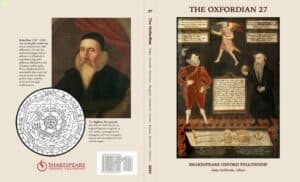
The 27th issue of The Oxfordian – the annual peer-reviewed journal of the Shakespeare Oxford
Fellowship – is now available on the SOF website for members with their password, while non-members can access one free article and one free book review from the issue by clicking here:
https://shakespeareoxfordfellowship.org/the-oxfordian/
Members can find the password for The Oxfordian by clicking on “My Account” at the top right hand corner of this page and scrolling down on the account Dashboard.
Those who wish to purchase a print copy of TOX 27 can do so for $14.99 by going to Amazon.com, the only place it is available for purchase. The 300-page issue offers 10 articles and 7 book reviews, including these highlights:
In “The Earl of Oxford’s Allegory Portrait,” Katherine Chiljan writes that a 16th century allegorical painting depicts a young courtier, an aged man standing opposite to him, a skeleton in an open coffin, and Father Time holding an hourglass and sickle – see the four-color front cover. These figures are surrounded by excerpts from the Psalms and three anonymously written verses. This paper proposes that the painting’s young courtier is the 17th Earl of Oxford, that analysis of the anonymous verses, which have Shakespearean echoes, point to Oxford’s authorship, and that the painting’s Christian theme aligns with Oxford’s biography, his patronage of Biblical studies, and contemporary comments that he was religious.
In “Who Really Wrote Love’s Labour’s Lost?” Rima Greenhill proposes that the Earl of Oxford wrote Love’s Labour’s Lost for several compelling reasons. Love’s Labour’s Lost was written to amuse Elizabeth’s aristocratic audience immersed in Anglo-Russian economic affairs through the Muscovy Company, of which many were founding or active members. Contemporary understanding of the play is thus closely linked to the fate of the Company. Shakespeare clearly read or heard first-hand accounts of its ambassadors, even those never published in his lifetime, which he then incorporated into the play. Thus, it appears evident from the knowledge displayed in the text that Shakespeare was a court insider and that the 17th Earl of Oxford is the strongest candidate to be its author.
In “Horestes to Hamlet: Topical Political Allegories of their Time,” Earl Showerman states that Shakespeare’s tragedy of Hamlet was not only dense with classical allusions, but the plot was modeled on the Orestes dramas of Aeschylus and Euripides. Understanding the connection between Greek characterizations of Orestes and Hamlet leads naturally to the consideration that the Tudor classical interlude Horestes may be an unrecognized source for Shakespeare’s Hamlet.
In “A Reassessment of Shakespeare’s 1 Henry VI,” Elisabeth Waugaman poses the question – is it a bad play or have we failed to understand what Shakespeare was trying to accomplish? She provides the historical context that enables one of Shakespeare’s earliest plays to undergo a reassessment as to its value as a historical drama in revealing the interplay of English and European politics involving Elizabeth, Joan of Arc and the de Vere Oxfords.
In “Who Was Rosaline in Love’s Labour’s Lost?” Matt Hutchinson writes that the character of Rosaline from Love’s Labour’s Lost has long interested Shakespearean scholars. Not only is she one of Shakespeare’s wittiest and most colorful heroines, but many have seen numerous parallels between her and Shakespeare’s “Dark Lady” from Shake-speares Sonnets. Rosaline may be based on Anne Vavasor, while A.L. Rowse put forward an argument that Shakespeare’s heroine may have been modeled on Emilia Lanier. This paper examines whether a third candidate, Penelope Rich, is the real-life model for Rosaline.
In “Did Shakespeare Contribute to the Marlowe Canon?” Robert R. Prechter conducts an in-depth investigation as to Shakespeare’s hand in Marlowe’s plays and poems. While a handful of scholars believe Christopher Marlowe wrote the Shakespeare canon, a larger contingent believes that Marlowe and Shakespeare were collaborators. Prechter finds no evidence for either proposition, though he finds evidence that Shakespeare – the 17th Earl of Oxford – wrote some of the material attributed to Marlowe. This paper examines the historical and philological evidence, and proposes which plays may have been written, wholly or in part, by William Shakespeare.
In “The Moses of Avon,” Verne Fanning writes that two of the most significant but neglected scientific works are J. Thomas Looney’s “Shakespeare” Identified and Sigmund Freud’s Moses and Monotheism. These two works share a methodology that has gone universally unrecognized. Inspired by Looney’s identification and informed by contemporary archaeology, Freud discovered a psychological phenomenon concealed in the authorship mythology of his two favorite literary traditions—Shakespeare and the Hebrew Bible.
In “A Comparative Case Study of The Merchant of Venice,” Jens Munnichow examines four German translations of Shakespeare’s Venetian comedy in recommending which are best suited for performance on the stage.
In “The Rise of Democracy and the Decline of Esoteric Writing,” Matt Hutchinson argues that, in response to the orthodox contention that no scholar questioned Shakespeare’s authorship until the middle of the 19th century, this was the time when esoteric writing disappeared, and experts were then able to question the authorship controversy explicitly. Hutchinson shows that the historical evidence demonstrates that scholars and literary writers were questioning Shakespeare’s authorship implicitly since 1593.
Rounding out the issue is a recent reprint of a “Comprehension of the Shakespeare Authorship Question through Deep Impostors Approach,” by Zeev Volkovich and Renata Avros. This article investigates the authorship question using a novel approach called the “Deep Impostor” methodology. The method uses a set of known impostor texts to analyze the origin of a targeted collection of texts. Both the target texts and impostors are divided into an equal number of word segments. A deep neural network, either a Convolutional Neural Network (CNN) or a pre-trained BERT transformer, is then trained and fine-tuned to differentiate between impostor segments. The study considered the four Shakespeare plays of Comedy of Errors, A Midsummer’s Night Dream, Henry VI and Timon of Athens, as well as The London Prodigal, A Yorkshire Tragedy, Locrine and Arden of Faversham to be “suspicious creations” and likely had co-authors in addition to Shakespeare, such as Christopher Marlowe and Thomas Middleton, or written by someone other than the traditional author.
Moreover, the book section offers seven reviews of the following titles.
Shakespeare Revealed and Shakespeare Discussed, both edited by James Warren
Shakespeare’s Greater Greek, by Earl Showerman
Shakespeare’s French Connection, by Margrethe Jolly
Shakespeare Lied, by Sky Gilbert
Fair Youth, by Lawrence Wells
Ben Jonson, edited by Roger Stritmatter
A Secular Tour of The Tempest, by William Niederkorn